Additive manufacturing simulation for DED and WAAM, on your own laptop

22 October 2026

A WAAM or DED part can look fine for twelve hours and then crack on the last layers. Or it comes off the substrate, the clamps release, and the plate bows by a couple of millimetres. By then the wire, the gas and the machine time are already spent.

Every layer heats and cools the part. That thermal cycling drives distortion, residual stress, cracking and poor bonding between layers. Most teams know it’s happening. What they lack is a quick way to see where it will happen before they press start.

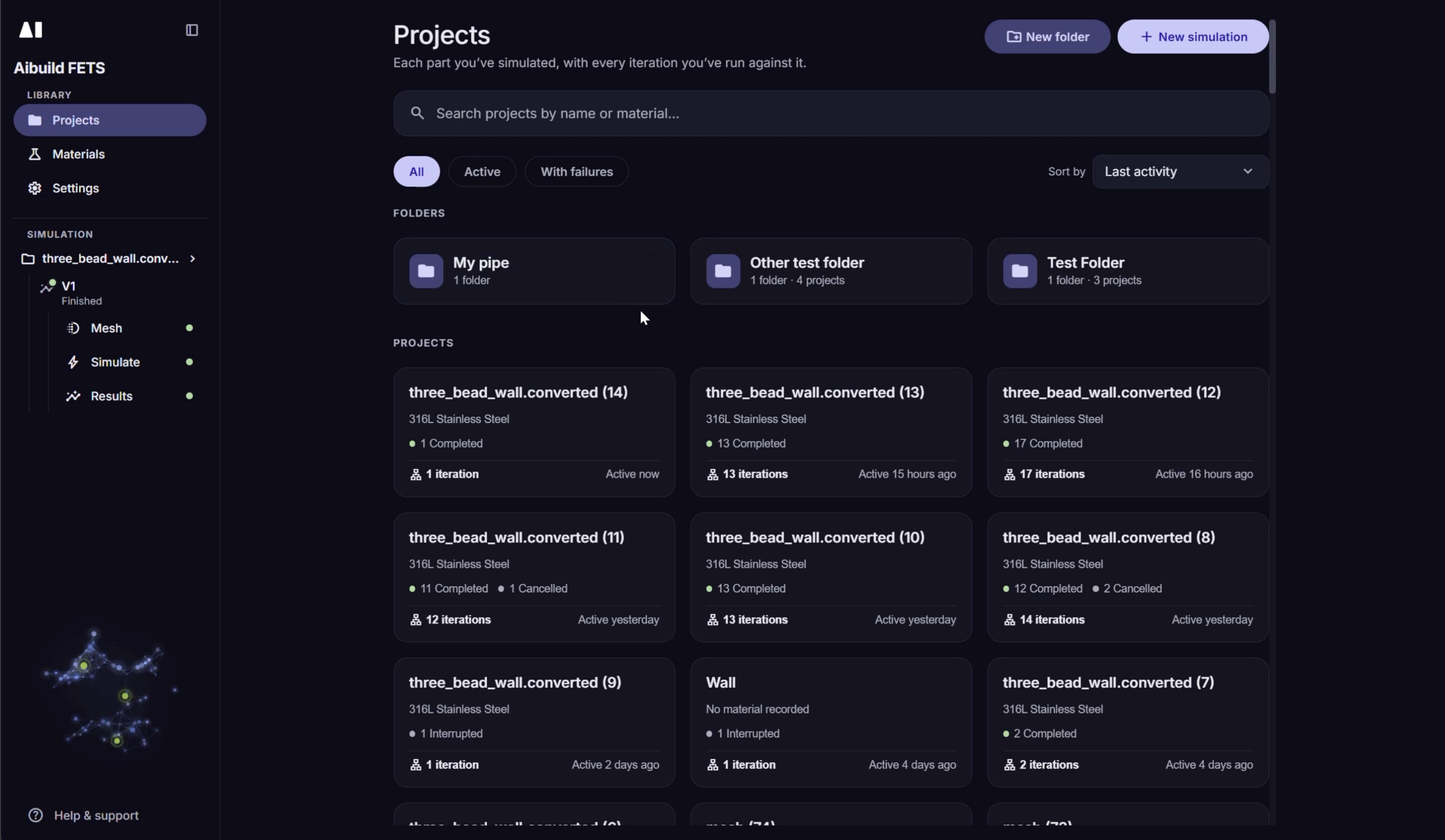
Aibuild FETS is thermomechanical simulation software for directed energy deposition (DED), wire arc additive manufacturing (WAAM) and large-format additive. It predicts temperature, stress, distortion, crack risk and interlayer bonding problems from your G-code, in minutes, on a standard workstation or laptop with an NVIDIA GPU.
Why simulation gets skipped.

Additive manufacturing simulation is not new. The problem is how it fits into the working week.

Most process simulation tools were built for powder bed fusion and run on the CPU. For a large DED or WAAM part with a million elements and a print lasting a day or more, a single run can take many hours, sometimes days, and usually needs dedicated HPC hardware and an FEA specialist to set it up. When one answer takes that long, teams run it once, if at all, and fall back on trial and error at the machine.

We built FETS so simulation can sit inside the engineering loop. You should be able to try a different dwell time, clamping layout or build strategy and see the result before lunch.

What Aibuild FETS predicts.

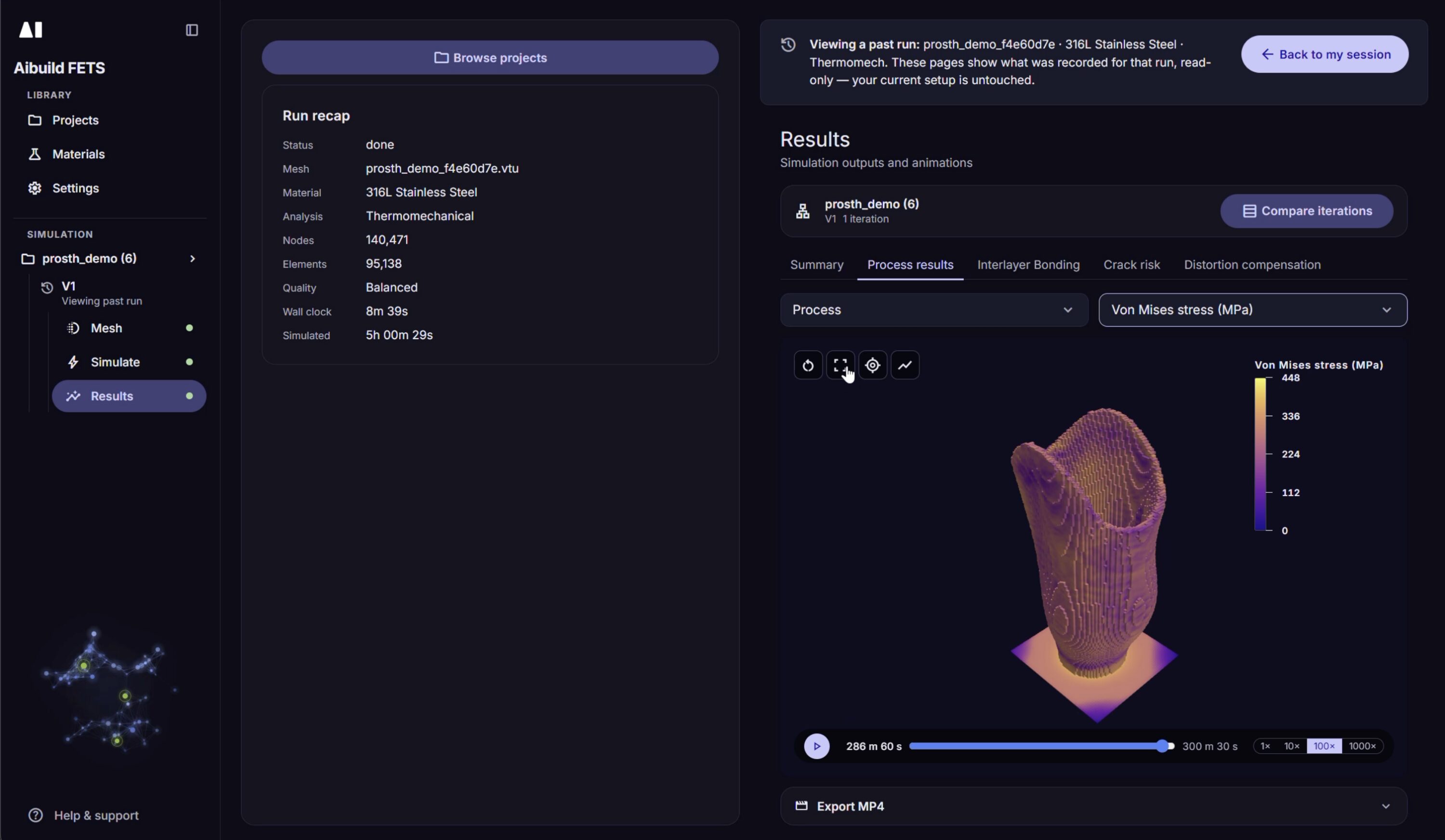
FETS runs a layer-by-layer thermomechanical simulation of the build and presents the results across six views:

  • Temperature. The thermal distribution at any point during the build.
  • Stress. Von Mises stress through the part and substrate.
  • Displacement. Predicted distortion and warpage, so you can check you have enough stock left for machining.
  • Interlayer bonding. Regions where interpass temperature falls outside your material’s range, flagging slumping when it’s too hot and poor adhesion when it’s too cold.
  • Crack risk. Regions where stress approaches the material’s ultimate tensile strength.
  • Summary. The key findings and inputs in one place, exportable as a PDF report to share with your team.

The report also recommends a wait time for each layer, calculated from that layer’s own cooling profile. Applying those in your CAM software replaces a single blanket dwell time, which can stretch a large build by hours without making it safer.

How it works.

Import your G-code from any CAM software that exports Marlin G-code, including Siemens NX, Fusion and most dedicated additive toolpath software. Planar and non-planar toolpaths both work, so robotic and multi-axis builds are covered. You can also import a custom substrate if you’re building onto a curved or pre-machined part.

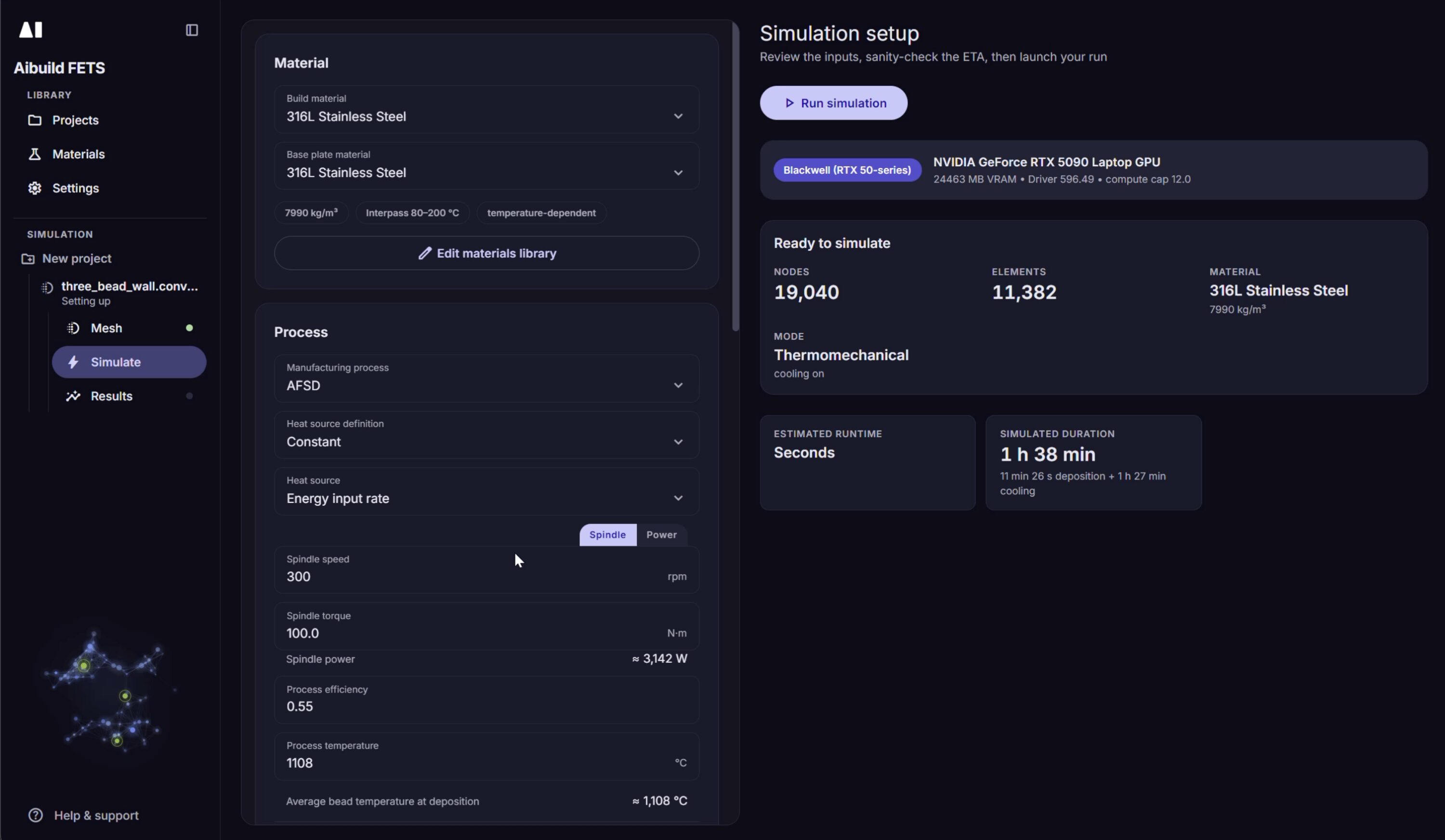
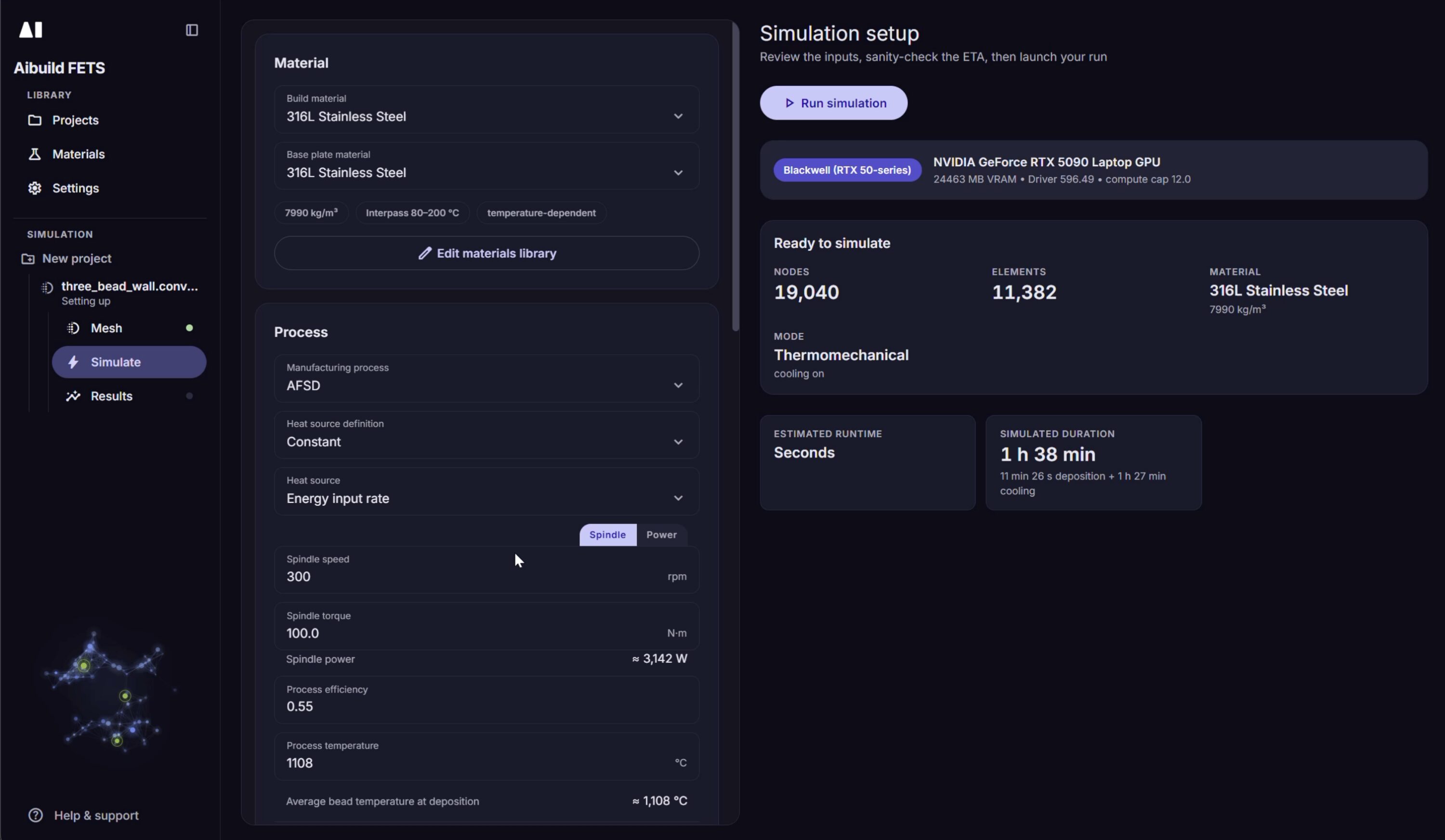
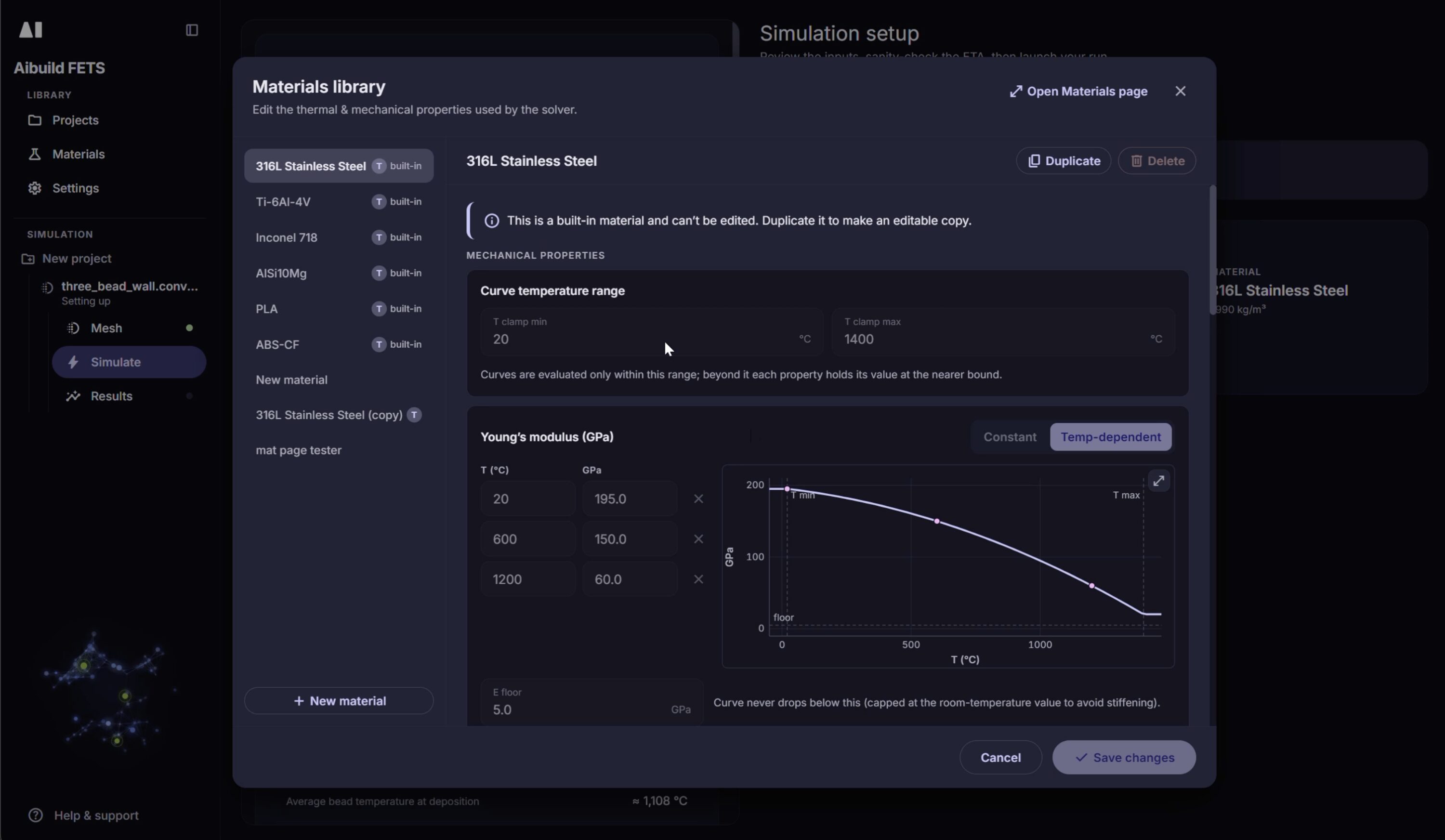
Choose a built-in material preset (316L stainless steel, Ti-6Al-4V, Inconel 718, AlSi10Mg, PLA or ABS-CF) or enter your own properties. Pick which edges are clamped, set the simulation quality, and run.

FETS was written from scratch to run on the GPU. Instead of working through elements one at a time on the CPU, it solves the whole finite element problem in parallel across thousands of GPU cores. That is why it runs on a laptop and why there is nothing to install on a cluster.

FETS supports DED (laser wire and laser powder), WAAM, additive friction stir deposition (AFSD), fused granular fabrication (FGF) and fused filament fabrication (FFF), on gantry and robotic systems. It does not cover laser powder bed fusion in this version.

Build validation you can check.

A simulation is only useful if its answers match the real part. Aibuild FETS has been validated against independent experimental data.

WAAM distortion, with Additure. As part of COMPADDITIVE, an Innovate UK-funded project with Additure, AMRC, Prodigma and Turkish Aerospace, Additure printed a WAAM wall on a clamped steel plate. They filmed every layer with a calibrated infrared camera and 3D-scanned the part before and after printing.

FETS simulated the whole build, including every weave stroke, the cool-down and the clamp release. It predicted the plate bow at 1.86 mm against 1.85 mm measured, within 1%, with about 0.1 mm RMS error across the full part surface. The full simulation of a 30-minute print plus cool-down ran in 6.2 minutes on a single laptop GPU.

DED thermal history, with NIAR. The National Institute for Aviation Research validated FETS thermal simulation for DED against thermocouple measurements, with an average per-layer error of 3.27%.

The full Additure methodology, including the two calibration parameters and the measurement setup, is in the Aibuild FETS validation report.

Your data stays on your machine.

FETS runs entirely offline. Your G-code, material data and results stay on your own hardware, and nothing is sent to Aibuild. For aerospace and defence programmes that can’t put part geometry into a cloud tool, that removes a whole approval conversation.

Where FETS fits, and where it doesn't.

FETS is built for deposition-based processes, where parts are large, prints are long and thermal cycling is the main risk. If your work is mainly laser powder bed fusion, or you need melt pool and microstructure modelling, a full multiphysics suite is the better tool today.

If you run DED, WAAM or large-format extrusion and want to know where a part will distort or crack before you commit the material and machine time, FETS was built for that.

Try it on your own build.

Aibuild FETS comes with a free trial. You get the installer, a short guide and example files, and you can run simulations on your own hardware with our team on hand if you have questions. 

FAQ

What is Aibuild FETS?

Aibuild FETS is thermomechanical simulation software for DED, WAAM and large-format additive manufacturing. It predicts temperature, stress, distortion, crack risk and interlayer bonding from G-code, running in minutes on a standard workstation or laptop with an NVIDIA GPU.
Can Aibuild FETS predict distortion in WAAM parts?

Yes. In an independent validation with Additure under the Innovate UK COMPADDITIVE project, Aibuild FETS predicted WAAM plate distortion of 1.86 mm against 1.85 mm measured, with about 0.1 mm RMS error across the part.

Does Aibuild FETS need HPC or a cloud connection?

No. Aibuild FETS runs offline on a Windows machine with an NVIDIA GPU. No HPC, no internet connection and no cloud upload is needed, so design data stays on your hardware.

Which CAM software works with Aibuild FETS?

Aibuild FETS imports Marlin G-code, which most professional additive toolpath software can export, including Siemens NX and Fusion. Aibuild CAM is not required.

Does Aibuild FETS support laser powder bed fusion?

Not in the current version. Aibuild FETS supports DED, WAAM, AFSD, FGF and FFF on gantry and robotic systems. Laser powder bed fusion is on the roadmap.