Additive thermomechanical simulation.
Finite element thermomechanical simulation that’s up to 10,000× faster than existing solutions. It's validated by US aerospace body NIAR and delivers thermal, thermomechanical, distortion and stress simulation to any CAM software.
Get better builds.
Simulation outputs cover thermal, thermomechanical, distortion and residual stress. There is no requirement to change your workflow, your software stack or your hardware. Aibuild FETS slots in around the way you already work.
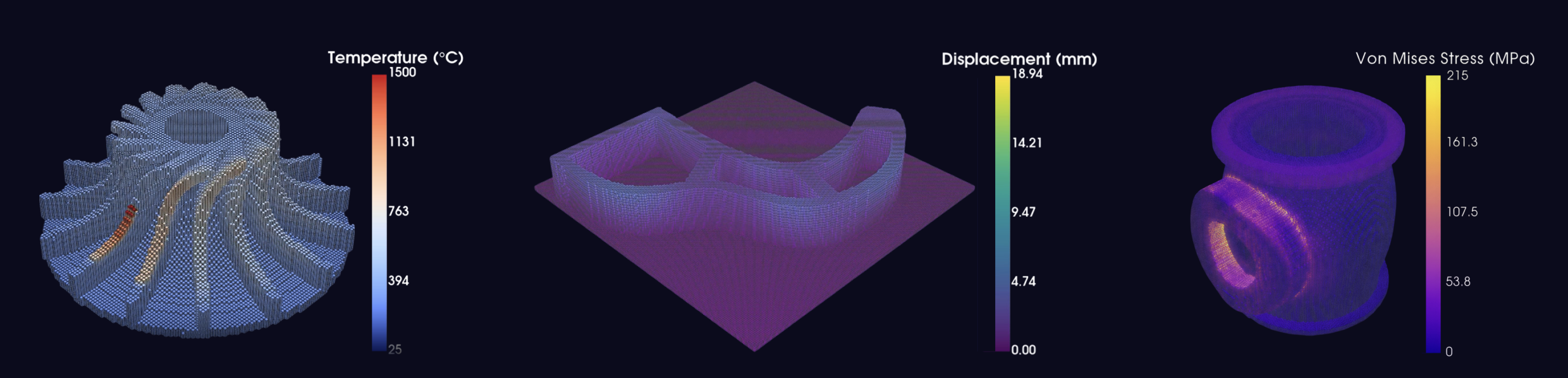
Built for DED, WAAM, FGF, FDM, AFSD.
Aibuild FETS supports the full range of large format and metal additive manufacturing processes across DED, WAAM, AFSD, FGM and FFF, covering both metals and thermoplastics. It is CAM agnostic, works with your existing toolpaths, runs on standard hardware and requires no specialist setup or onboarding.
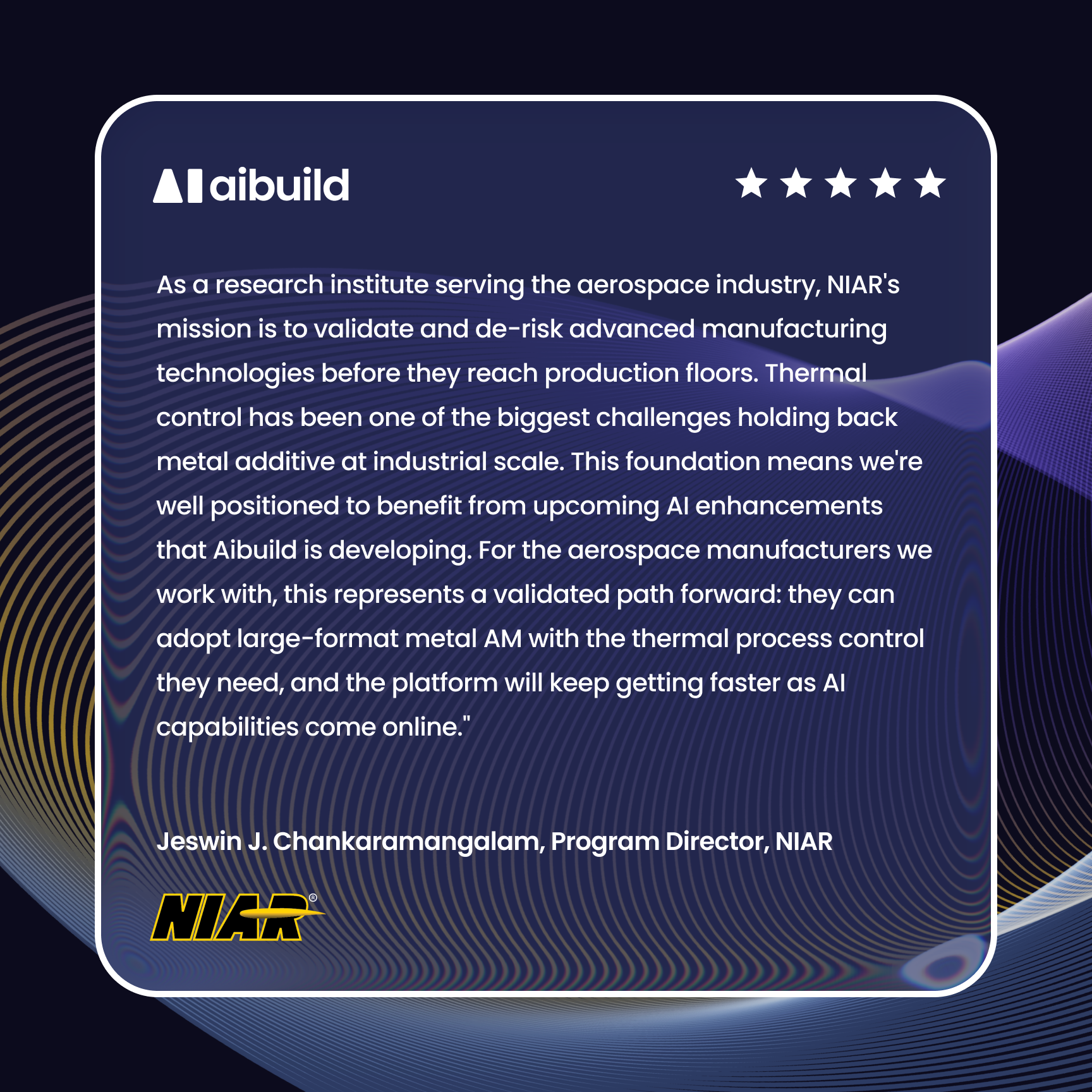
Validated by NIAR.
Read what the Program Director of NIAR thought about Aibuild FETS.
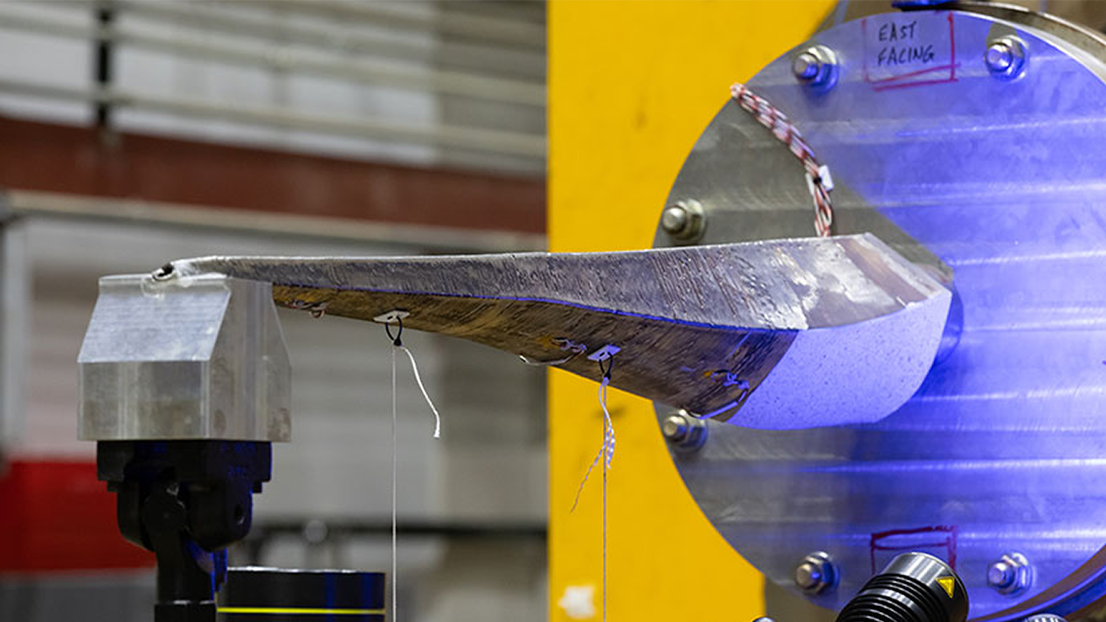
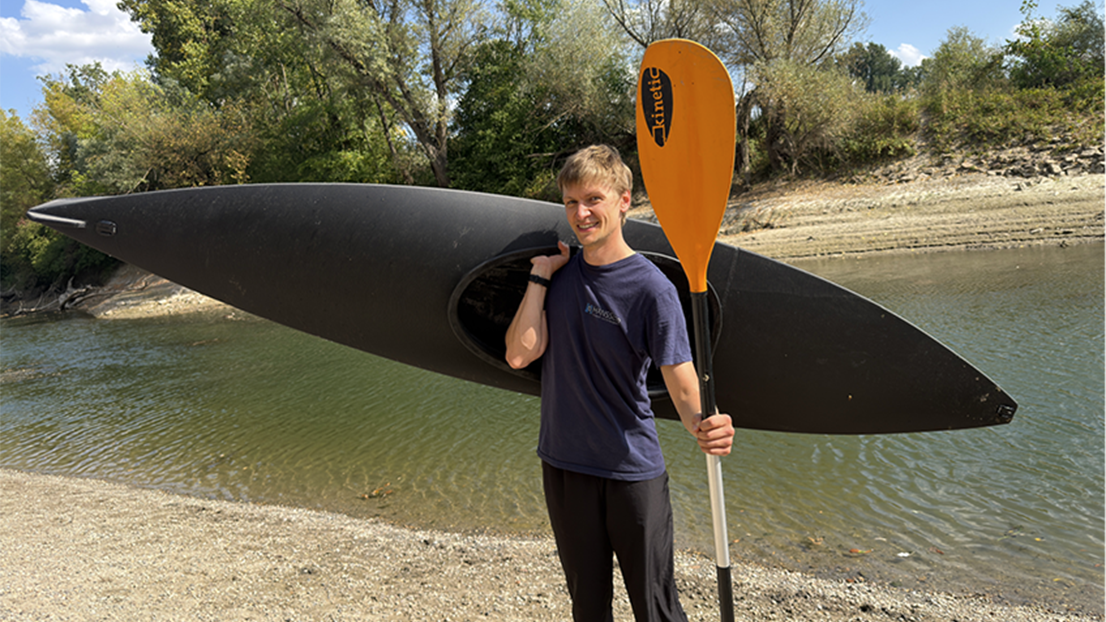
Aibuild FETS achieved 99% accuracy on a WAAM weave wall.
This validation was performed as part of COMPADDITIVE, a research project funded by an Innovate UK grant, in collaboration with Additure, AMRC and Turkish Aerospace Industries.
Developed by engineers, for engineers.
Aibuild FETS is CAM agnostic and requires no specialist computers. It integrates directly into your existing workflows across a wide range of manufacturing environments. Plus the easy calibration means teams are up and running quickly, without lengthy onboarding or specialist training.
FAQs
What is Aibuild's Finite Element Thermomechanical Simulation (FETS)?
Aibuild FETS is finite element simulation software built specifically for large format and metal additive manufacturing. It delivers thermal, thermomechanical, distortion and residual stress simulation up to 10,000 times faster than existing FEA solutions, returning results in seconds to minutes on standard hardware without requiring specialist equipment or dedicated FEA expertise.
Unlike traditional simulation tools that operate outside the manufacturing workflow, Aibuild FETS is CAM agnostic and integrates directly into existing toolpath and process workflows. It is powered by NVIDIA CUDA-X GPU acceleration and has been independently validated by NIAR, the National Institute for Aviation Research.
For engineering teams working with DED, WAAM, FGF, FDM and AFSD processes, Aibuild FETS makes it possible to predict build outcomes, catch failure risks and iterate on process parameters before a single layer is deposited.
How is Aibuild FETS different from a standard FEA thermal solver?
Standard FEA thermal solvers were not built for additive manufacturing. They require manual mesh reconstruction every time a toolpath changes, operate outside the CAM environment as a separate tool in a separate workflow, demand significant HPC hardware investment often exceeding one million dollars and return results after hours or days of compute time. For engineering teams running iterative process development on DED or WAAM builds, that speed and friction makes routine simulation impractical.
Aibuild FETS is different in every one of those areas.
It is built natively for additive manufacturing processes, meaning toolpath changes flow directly into simulation without manual reconstruction. It integrates into the existing CAM workflow without requiring a platform switch.
It runs on standard hardware without specialist infrastructure. And it returns thermal, thermomechanical, distortion and residual stress results up to 10,000 times faster than conventional FEA tools, in seconds to minutes rather than hours or days.
Critically, that speed does not come at the cost of accuracy. Aibuild FETS has been independently validated by NIAR, the National Institute for Aviation Research, achieving 96.8% mean prediction accuracy on real stainless steel 17-4PH Wire Arc DED builds. The accuracy is equivalent to high fidelity FEA. The speed is in a different category entirely.
Which materials and processes does Aibuild FETS support?
Aibuild FETS supports today's most widely used additive manufacturing processes including Directed Energy Deposition (DED), Wire Arc Additive Manufacturing (WAAM), Friction Stir Additive Manufacturing (AFSD), Fused Granulate Fabrication (FGF), and Fused Filament Fabrication (FFF), covering both metals and thermoplastics.
Simulation outputs cover thermal analysis, thermomechanical behaviour, distortion prediction and residual stress distribution, giving engineering teams a complete picture of build performance before printing begins.
Because Aibuild FETS is CAM agnostic, it works with toolpaths generated by any CAM platform and requires no changes to existing software or hardware setups. Engineers working across robotic and gantry systems with metals including steel and titanium alloys, as well as high performance thermoplastics, can integrate Aibuild FETS directly into their current workflow without disruption.
What is the difference between Aibuild CAM existing thermal analysis and FETS?
Aibuild CAM thermal analysis is optimised for speed. It produces a temperature envelope in minutes and is ideal for low-conductivity materials (e.g. carbon-fibre-reinforced polymers) or early-stage concept validation. Its simplifying assumptions limit accuracy on dense or high-conductivity geometries.
Aibuild FETS gives you full finite element simulation across thermal, thermomechanical, distortion and residual stress outputs. It models the complete physics of the build including the path the tool takes, the thermal history at every layer, mechanical response, stress accumulation and distortion across the full geometry. This level of fidelity matters most for dense or high-conductivity materials like steel and titanium alloys, complex geometries, and any application where a simplified thermal estimate is not sufficient to validate the build with confidence.
CAM thermal analysis makes simplifying assumptions that work well in certain material and geometry contexts. FETS applies full finite element rigour validated by NIAR to 96.8% mean prediction accuracy, making it the right tool when the build is complex, the material is demanding, or the cost of getting it wrong is high.
Thermal simulation for large format additive manufacturing.
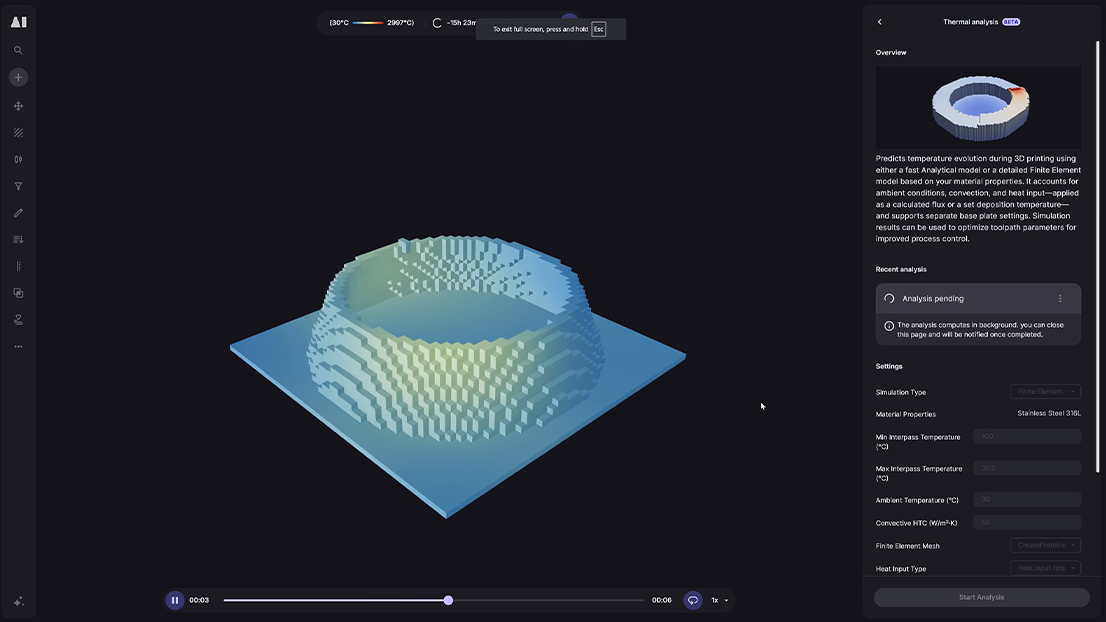
Large format additive manufacturing processes including DED, WAAM, FGF, FDM and AFSD are highly sensitive to thermal conditions during deposition. Interpass temperature, heat accumulation, cooling rates and thermal gradients all directly affect material properties, dimensional accuracy and build integrity. Aibuild FETS delivers full thermal simulation for large format additive manufacturing in seconds, on standard hardware, integrated directly into the existing CAM workflow. Up to 10,000 times faster than traditional FEA thermal solvers, it has been independently validated by NIAR to 96.8% mean prediction accuracy and is trusted by US aerospace manufacturers for production process validation.
What is WAAM distortion prediction software.
Distortion in WAAM and DED is caused by thermal gradients that develop as material is deposited and cools unevenly across the build geometry. Predicting and controlling distortion before printing is critical to producing parts that meet dimensional tolerances. Aibuild FETS delivers full distortion simulation as part of its thermomechanical output, returning results in seconds to minutes on standard hardware. Engineers can see exactly where distortion will take a part out of tolerance, adjust toolpath strategy accordingly, and validate the corrected build before committing to a print run. Independently validated by NIAR for aerospace applications, Aibuild FETS is the fastest distortion prediction tool available for WAAM processes.
How to prevent failed builds in DED and WAAM.
The most reliable way to prevent failed builds in DED and WAAM is simulation before printing begins. Interpass temperature going out of range, excessive residual stress and distortion beyond tolerance are the leading causes of build failure in both processes and all three are predictable through finite element simulation. Aibuild FETS delivers full thermal, thermomechanical, distortion and residual stress simulation in seconds, giving engineers the ability to identify and design around failure risks before a single layer is deposited. Validated by NIAR and trusted by US aerospace, it is the fastest and most accessible simulation tool available for DED and WAAM process validation.