Built for metal 3D printing.

Introducing Aibuild Finite Element Thermal Simulation Add-On for thermal simulation and optimisation of metal AM processes and enhanced accuracy for polymer AM.

Get better builds.

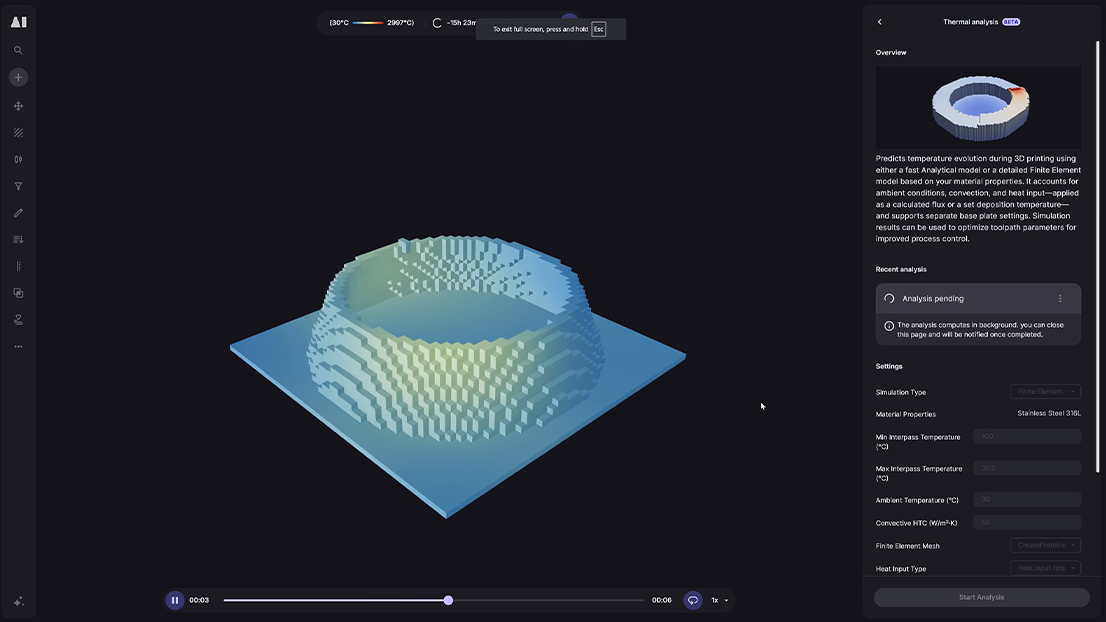
Automatic mesh generation.

Automatic generation of mesh elements based on your deposition path, angle and thickness.

Simulate thermal gradients.

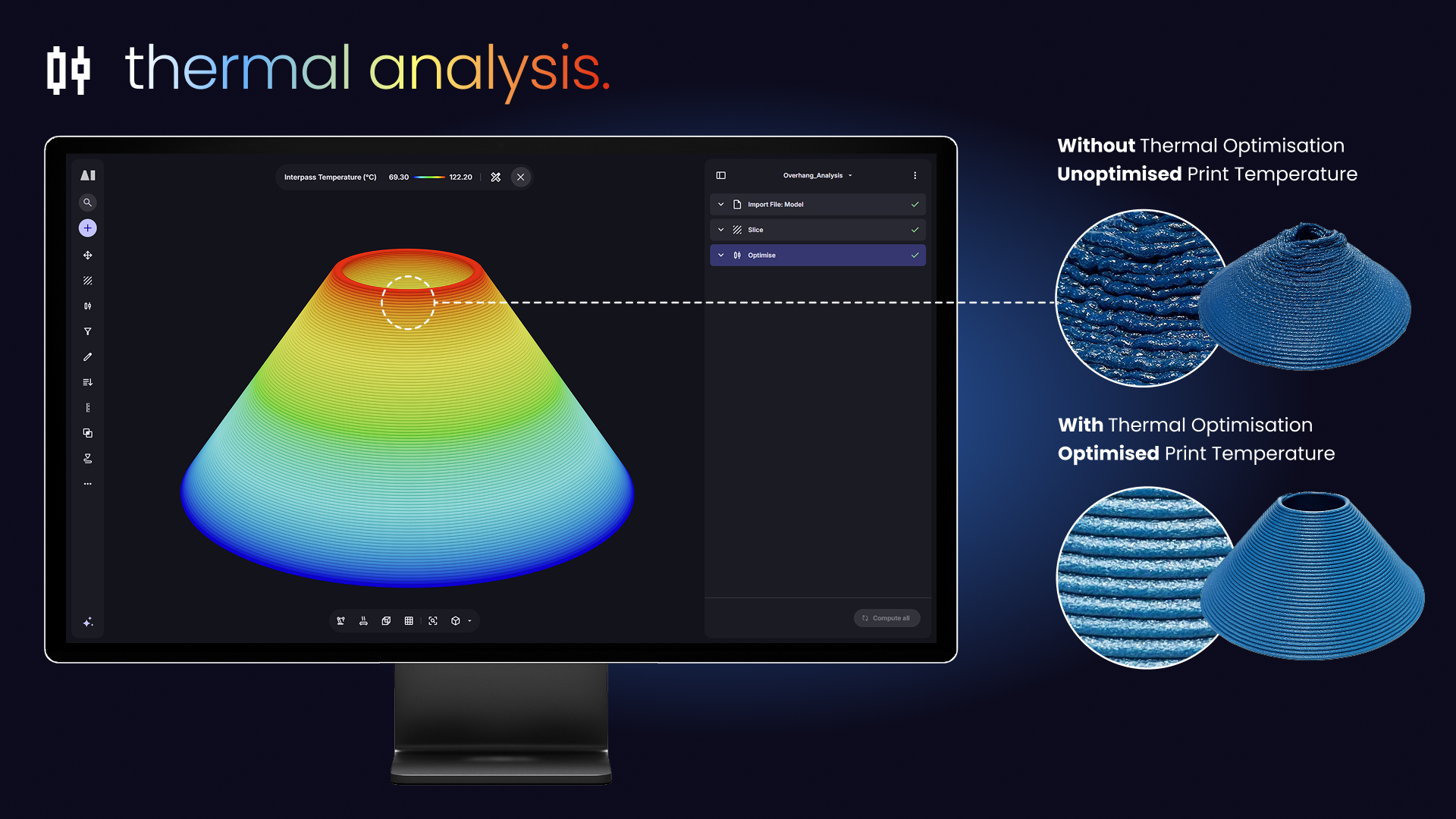
Watch the temperature evolution of your build, to identify hot spots and thermal cycling before printing.

Flag defects.

Each material has a suitable printing temperature range; FETS detects and flags sections that are too hot or too cold, and would result in part defects.

Inspect elements.

Select elements to read temperature, watch their evolution over the print, and correlate to real-life thermal measurements.

No HPC needed.

Compute using our Aibuild cloud service, meaning you don't need a high-performance computer to run advanced simulation.

Automatic optimization.

Automatic optimization of the toolpath through speeds, waits and process parameters to bring the interpass temperature into a safe printing range.

Program Director, National Institute for Aviation Research

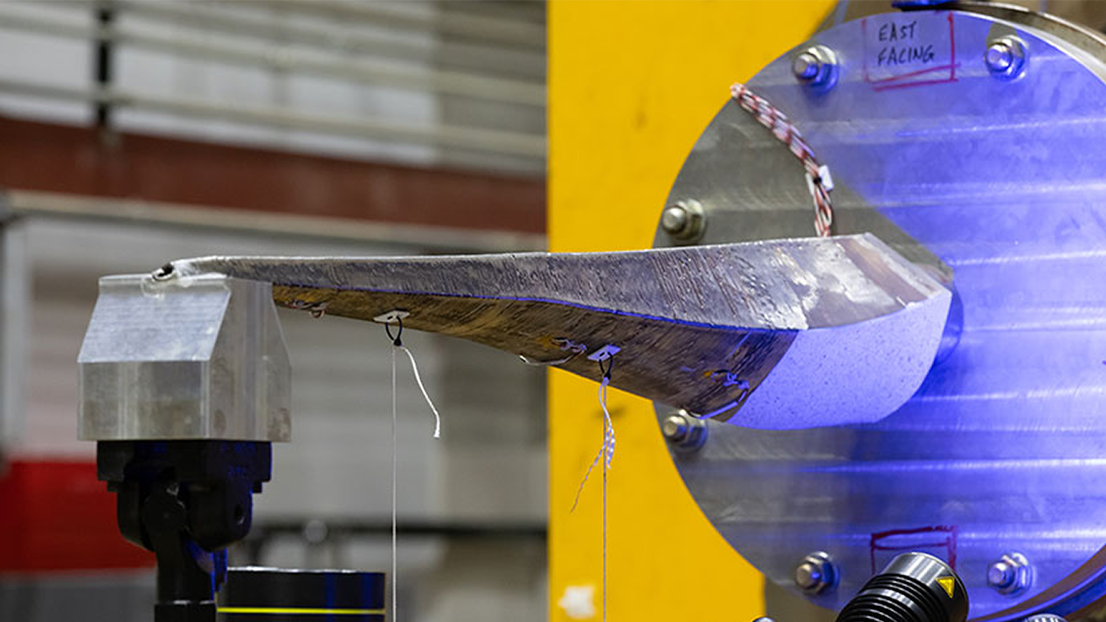
“As a research institute serving the aerospace industry, NIAR’s mission is to validate and de-risk advanced manufacturing technologies before they reach production floors. Thermal control has been one of the biggest challenges holding back metal additive at industrial scale. When we validated Aibuild’s FETS, what stood out was the GPU acceleration with NVIDIA’s CUDA. It made complex finite element thermal simulation fast enough to actually use in production workflows, not just as a research tool. This foundation means we’re well positioned to benefit from the next step: ultra-fast physics AI simulation using NVIDIA’s PhysicsNeMo framework, which Aibuild is developing to deliver speeds an order of magnitude faster than today. For the aerospace manufacturers we work with, this represents a validated path forward: they can adopt large-format metal AM with the thermal process control they need today, and benefit from AI-accelerated simulation speeds as that technology matures.”
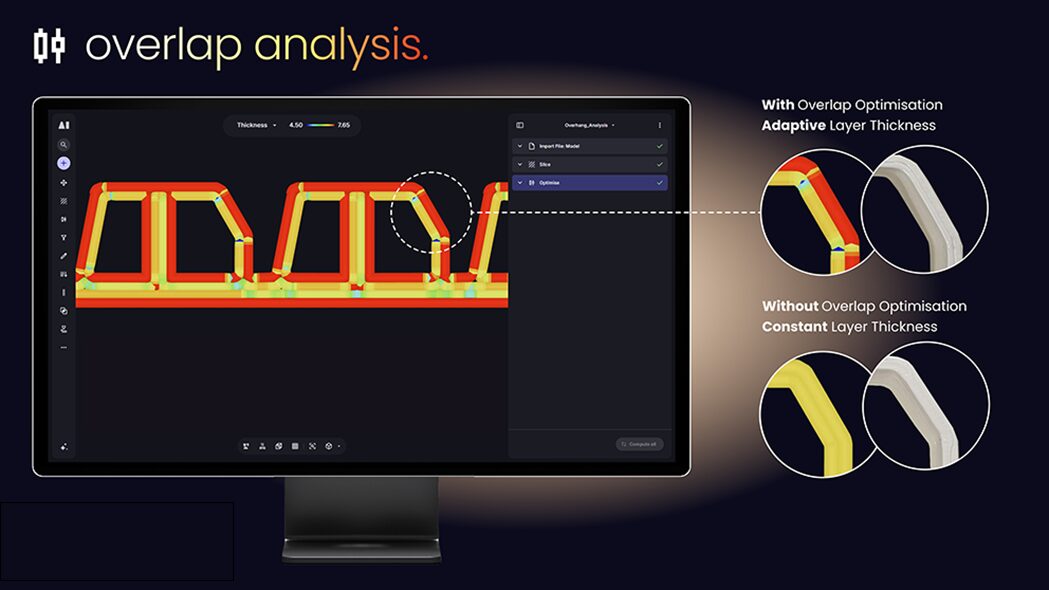
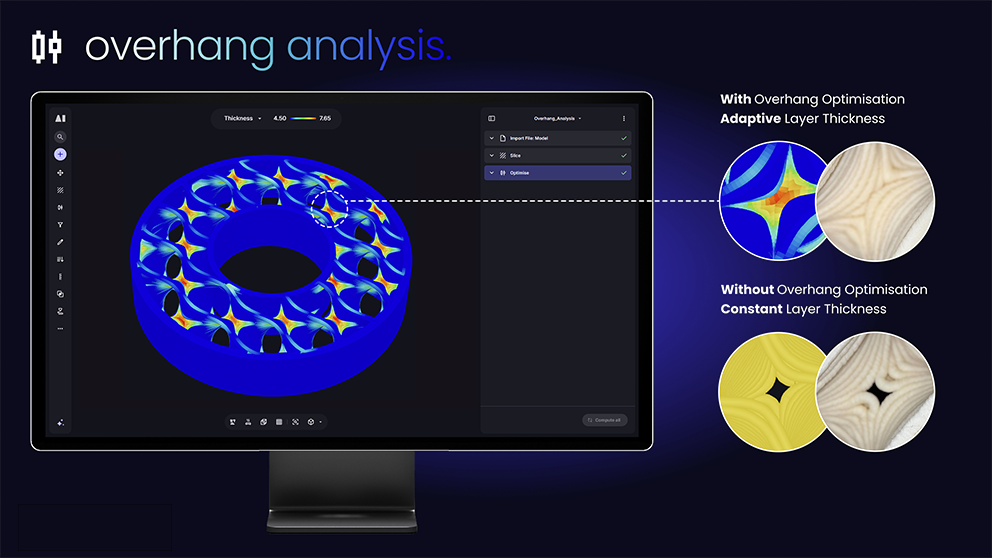
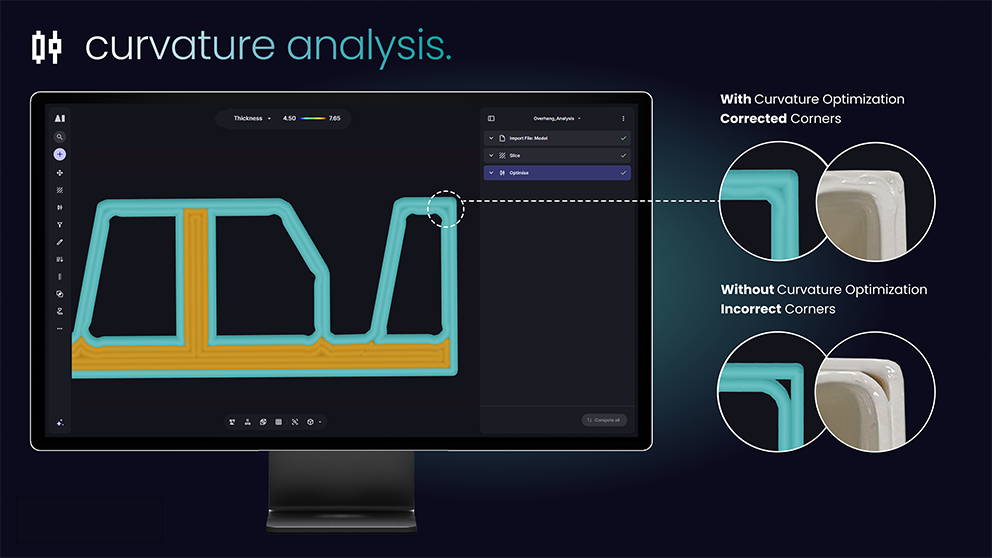
Our other analysis tools built for LFAM.

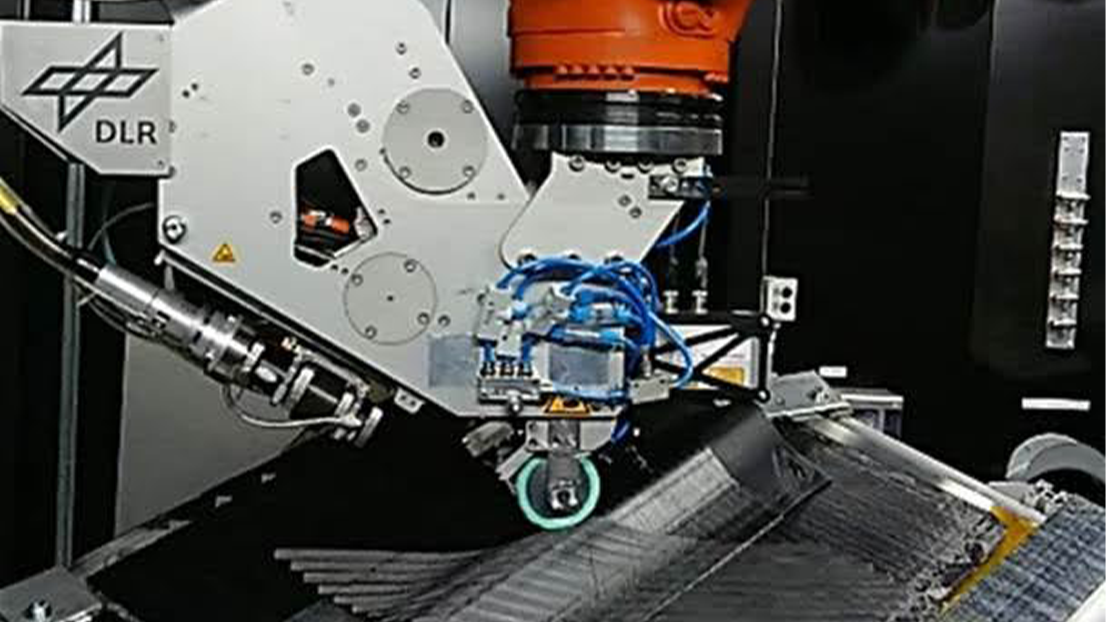
Aibuild Finite Element Thermal Simulation Add-On works with metal DED, WAAM and polymer extrusion for both robotic and gantry LFAM systems. Get LFAM toolpath creation + print analysis for both polymer and metal + automatic toolpath optimisation in one tool.

FAQs

What is Aibuild's Finite Element Thermal Simulation (FETS)?

Aibuild FETS is a finite-element thermal solver built directly inside a CAM toolpathing engine for large-format additive manufacturing (LFAM). It predicts interpass temperatures across every layer of your build before printing starts, so engineers can fix thermal issues offline rather than discovering them mid-print.

Unlike external FEA packages, FETS is native to Aibuild's path planning UI. The same workflow used to generate toolpaths now drives simulation and optimisation.

Why does interpass temperature matter in large-format 3D printing?

Interpass temperature is the temperature of a deposited bead at the moment the next layer is laid on top. If it is too high, the bead sags; if it is too low, inter-layer cracks form and tensile strength drops. Both failures degrade mechanical properties and risk scrapping a multi-hour build.

In LFAM the problem is non-linear: conduction into the substrate, convection to air, and radiation off glowing metal all change every second. Without simulation, engineers can only react after defects appear rather than preventing them.

How is Aibuild FETS different from a standard FEA thermal solver?

Aibuild FETS is purpose-built for additive manufacturing, not adapted from general-purpose structural analysis software. Key differences include:

• CAM integration – simulation and toolpath generation share the same UI; results feed directly back into print parameters.
• GPU-accelerated, cloud-ready – reduces typical FE runtimes from ~100 hours (general-purpose) or ~30 hours (AM-specific FE) to approximately 4 hours on Aibuild Cloud.
• Bead-size-aware meshing – the FE mesh is derived directly from the toolpath, so resolution matches the actual deposition geometry.
• Automatic optimisation – the engine can auto-tune print speeds, layer waits, and process parameters against user-defined temperature rules.

Which materials and processes does Aibuild FETS support?

FETS is designed for any deposition-based LFAM process. Because it models full conduction, convection and radiation physics from first principles, it is not constrained to a specific material family. Users can pick from existing materials in Aibuild's library or create custom materials with their own thermal properties. The mesh resolution adjusts automatically to bead size, making it suitable for metals and polymer composites alike.

What is the difference between Aibuild's existing thermal analysis and FETS?

Aibuild's thermal analysis is optimised for speed. It produces a temperature envelope in minutes and is ideal for low-conductivity materials (e.g. carbon-fibre-reinforced polymers) or early-stage concept validation. Its simplifying assumptions limit accuracy on dense or high-conductivity geometries.

Aibuild FETS removes those assumptions. It takes longer to compute but scales accurately from sparse polymer parts to fully dense titanium or Inconel blocks. Both solvers remain available; Aibuild is investing in improving both tracks in parallel.